

Research Paper - Is AI removing the first rung on the career ladder?

Is it getting harder across the Ballarat region for young people to land their first professional job?
Dr Robert Layton
Chief Research Officer, BRAIN (Ballarat Region AI Network)
Contact Dr Layton at rob@brain.net.au
Presented June 2026
Is it getting harder across the Ballarat region for young people to land their first professional job? This paper asks if that is happening and, if so, how much of that is AI’s doing. Is AI removing the first rung on the career ladder? By “entry-level” we mean that first rung of professional work consisting of internships, graduate programs, cadetships and first jobs, typically taken in the early to mid twenties. The stakes compound, because a young person who cannot get a first job cannot get a second one. A blocked entry point harms today’s young people and tomorrow’s workforce alike.
The evidence is contested and heavily confounded but there are early indications of an issue worth investigating further. A general economic slowdown, corrections to pandemic-era over-hiring and rising employer costs have all weakened junior hiring since 2023, with or without AI. The question that matters is what happens inside the organisations still hiring: are they taking on the next generation, or skipping juniors in favour of experienced staff?
Our assessment is that AI is a plausible accelerant of a structural shift in entry-level work. The signal is strong in specific sectors and in United States data, but unproven economy-wide. In particular:
We focus on white-collar work because that is where the measured effects concentrate, however we will continue to monitor all employment types. Closer to home, we find almost nothing on how Ballarat’s businesses and young people are experiencing this shift. We propose to fill that gap, and we close this paper with a request for help in supporting this goal.
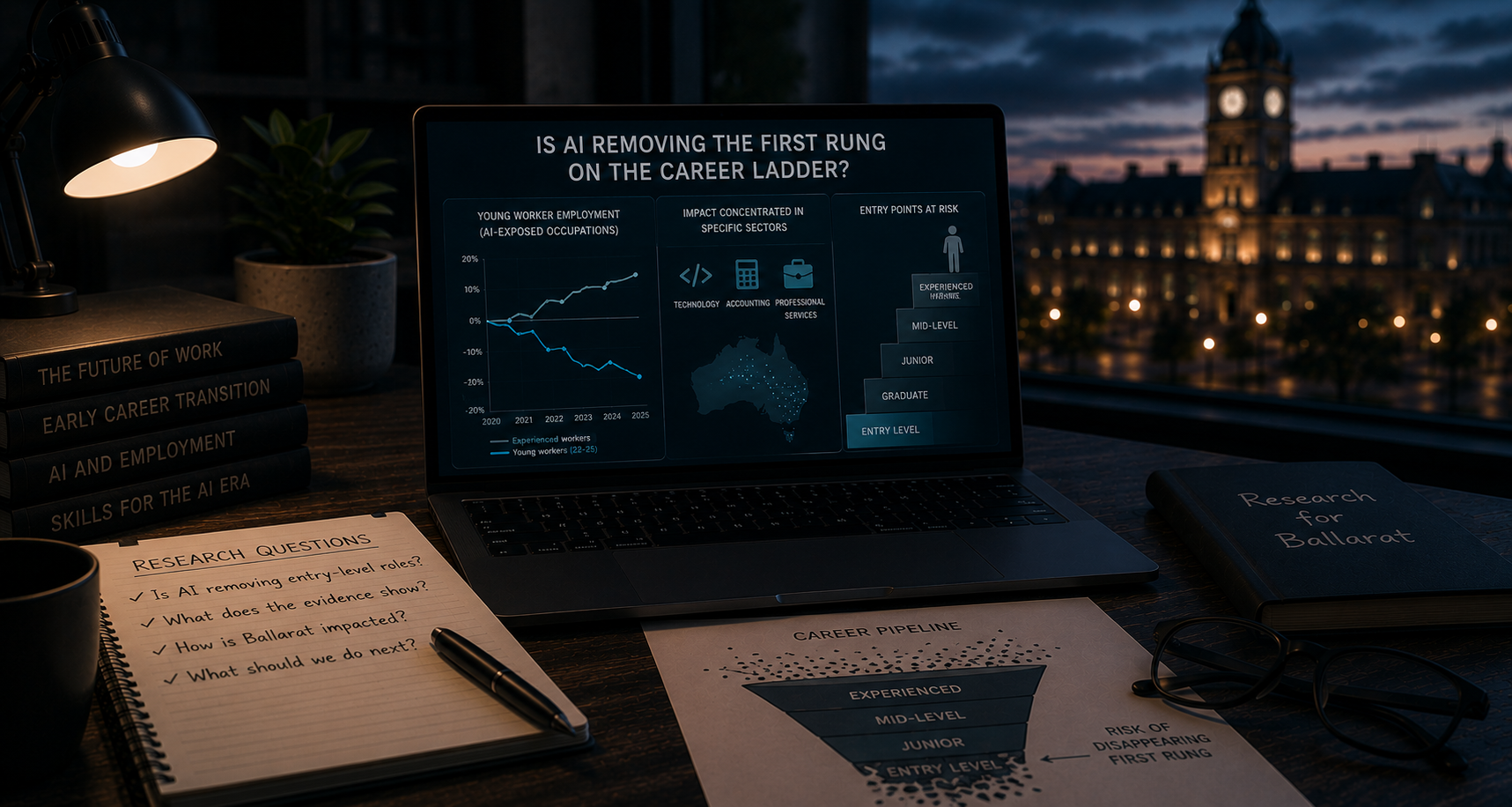
The strongest evidence that something real is happening comes from Stanford. Brynjolfsson, Chandar and Chen (2025) used US payroll records to identify the occupations whose tasks are most vulnerable to AI substitution, then tracked who held those jobs. Since late 2022, employment of 22-to-25-year-olds in the most exposed occupations has fallen 16% relative to experienced workers in the same fields, even after accounting for firm-level shocks. The declines appear where AI substitutes for whole tasks rather than augmenting them, a pattern the business cycle alone struggles to explain.
However, the case for caution is just as credible. The Budget Lab at Yale (2025, 2026) measured an effect close to zero on employment and wages through late 2025, including for younger workers, and observes that AI-exposed jobs have historically been less cyclical than others. This suggests that simple comparisons between exposed and unexposed occupations mislead.
In Denmark, Humlum and Vestergaard (2025) linked AI-adoption surveys of 25,000 workers to administrative records and found precisely estimated null effects on earnings and hours across 11 exposed occupations, early-career jobs included. Their data does end in 2024, before the current generation of more capable tools.
The United Kingdom showed more impact, where graduate hiring fell 8% in 2024/25, the first fall since the pandemic. The damage was concentrated in technology, accounting and professional services rather than spreading evenly across white-collar work (Institute of Student Employers 2025).
Australia, so far, looks less AI impacted. Graduate job postings fell roughly 15% year-on-year in 2025 and sit about 35% below their 2023 peak, yet they stabilised in early 2026 and remain above pre-pandemic levels (Indeed Hiring Lab Australia 2026). Postings in high-AI-exposure graduate roles declined more than average, but graduates are still finding work relatively easily, which led Indeed to judge that AI is not yet the primary driver. Jobs and Skills Australia (2025) agrees: it finds no current evidence of widespread entry-level displacement, cautions that local adoption is still early, and expects entry-level roles to transform rather than disappear, with these roles shifting toward judgement and oversight of AI outputs.
Not every Australian source is so sanguine. Fifth Quadrant’s SME Sentiment Tracker (2026) reports the share of SMEs with vacancies falling from 22% in FY24 to around 12% in FY26 to date, including a decline of roughly 29% in entry-level hiring that it calls structural rather than cyclical.
Weighing all of this, we treat AI as a plausible accelerant of a structural shift: strong in named sectors, unproven economy-wide, and difficult to separate from confounders so soon after the pandemic. Part of the disagreement is also mechanical, since these studies measure different yardsticks: employment of young workers, job postings, vacancy intentions.
Ballarat’s labour structure means its exposure to any AI-driven shift differs from the national picture. Modelled estimates for 2024/25 put around 64,300 jobs in the City of Ballarat, and the top five industries (Health Care and Social Assistance at 23.1%, Education and Training at 11.5%, Retail Trade at 9.7%, Construction at 9.4% and Manufacturing at 7.2%) account for about 61% of them (economy.id 2026).
The city has a lower weighting of workers in the most AI-exposed white-collar sectors: Professional, Scientific and Technical Services provides 5.3% of local jobs against 9.7% across Victoria, and Financial and Insurance Services 1.5% against 4.3%. Ballarat therefore has proportionally fewer of the desk-based junior roles most exposed to AI. The ones it does have, however, significantly impact local communities, the greater region, and state-wide economies.
No existing dataset isolates AI’s effect on entry-level roles in Ballarat or the broader Western Victorian region.
The national evidence is contested, and it is not adjusted for Ballarat-based demographics. A targeted local effort is the only way to learn whether our region is exposed, insulated by its weighting toward health, education and construction, or simply lagging the national trend.
BRAIN will build the methodology to gather this evidence directly, starting with a survey of local employers and early-career workers. We want to know whether graduate and intern intakes are changing, whether firms attribute the change to AI or to costs and the economic cycle, which junior tasks are being automated here, and what AI literacy local employers now expect.
We are seeking partners: Ballarat employers, particularly in professional services, finance, health, education and government; education providers; and organisations working with young job-seekers. Partners will help shape the survey design and will receive the findings first. Fieldwork is planned for the second half of 2026. To take part, contact rob@brain.net.au. We welcome assistance at all levels.
Your link has expired. Please request a new one.
Your link has expired. Please request a new one.
Your link has expired. Please request a new one.
Great! You've successfully signed up.
Great! You've successfully signed up.
Welcome back! You've successfully signed in.
Success! You now have access to additional content.