

If AI Will Bring Jobs, What Jobs Will Those Be?

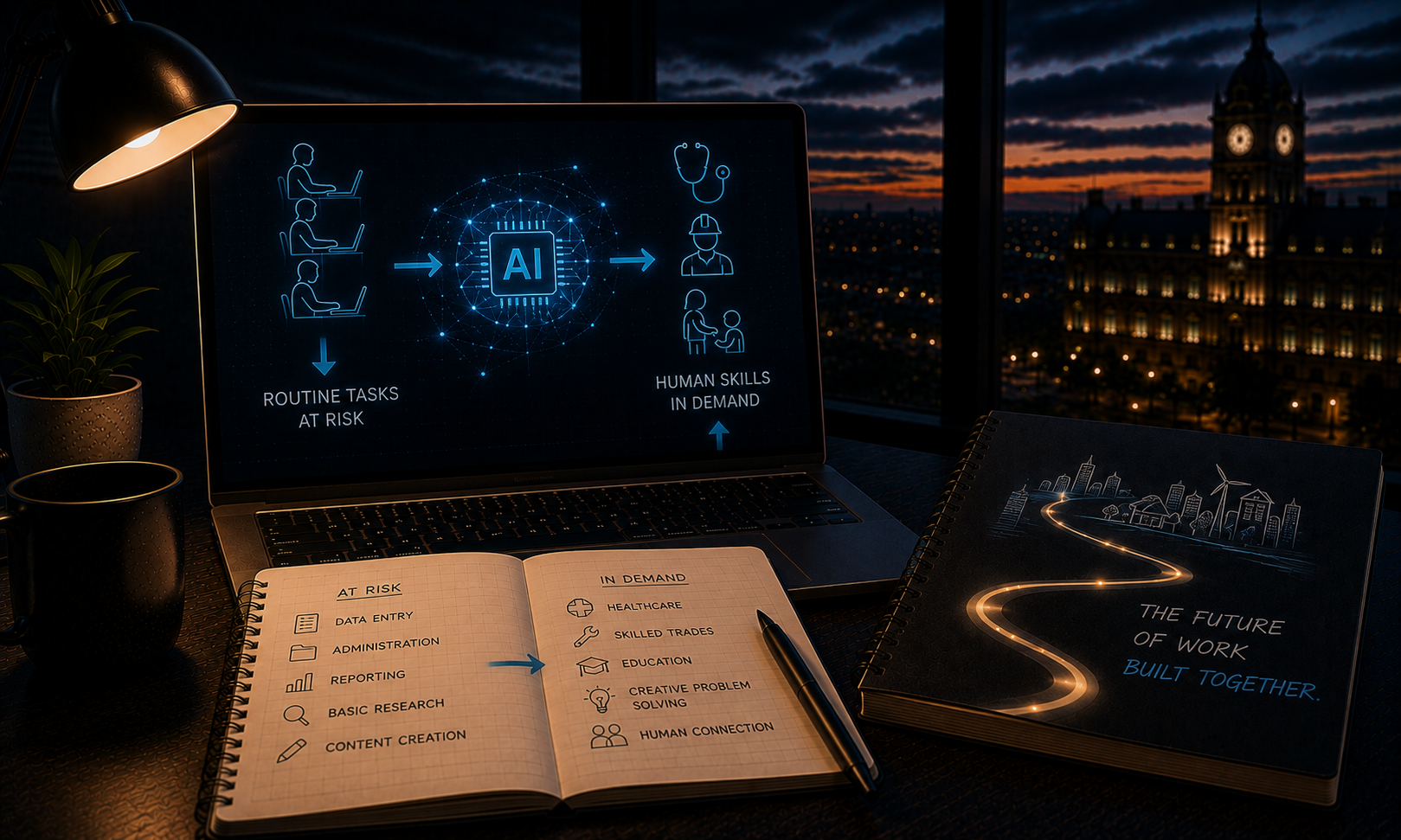
A common point in discussions about the future of AI is that AI will (or at least aims to) displace many workers from their current roles. What will those workers do? What should our kids and young people learn, to be job-ready in the future?
In this article, I'll hold a couple of assumptions as true, even though they are not guaranteed and very much up for debate. This keeps the scope manageable, as otherwise it would be a very long article if I tried to cover every possible scenario. Those key assumptions are:
In short: AI keeps improving, we will still need jobs, but for many people those won't be their current jobs. Whether these assumptions actually hold is beyond the scope of this article, but they are worthwhile things to debate. Maybe in a future article.
Many white-collar jobs are being replaced, devalued, or otherwise made less desirable as AI takes over some of the tasks these workers do. Examples of jobs being targeted by AI include:
As a general rule, I consider the jobs most at risk to be those where the person's value is being smarter than their clients, and doing things with that knowledge. This isn't just intuition. Exposure studies find that, unlike previous automation waves, generative AI most affects higher-paid, higher-educated white-collar work (Eloundou et al., 2024). And the effects are now showing up in real data, not just projections: freelance writing and design work dropped measurably within months of ChatGPT and image generators launching (Hui, Reshef & Zhou, 2024). Payroll data shows employment for early-career workers in the most AI-exposed occupations falling around 16% relative to their peers with young software developers down about 20% since late 2022 (Brynjolfsson, Chandar & Chen, 2025).
Note that all of the jobs above have already seen large amounts of automation. Photoshop started automating artistic tasks in the 1990s, Xero automates many common accounting tasks (and now parses receipts automatically), online research tools were getting smarter well before this generation of AI, and automating tasks is basically the job description of a software developer. AI is making these automations more flexible, and the potential impact is substantial.
Some jobs are generally considered fairly safe from AI automation. These jobs will very likely change due to AI, but not in ways that would dramatically displace current workers. Typically these are jobs such as:
There are other roles like this too. Teaching, childcare, engineers, pilots, just to name a few. Where the person is needed, either because the role is very physical and hands-on, or for regulatory reasons, these jobs are probably safer.
The deeper reason physical jobs are safe is Moravec's paradox (Moravec, 1988): tasks humans find easy, such as dexterous work in messy, unpredictable environments like a half-built house, remain the hardest for machines. Meanwhile abstract reasoning has turned out to be comparatively easy for AI. Every exposure study ranks trades like roofing and bricklaying at the very bottom of AI risk for exactly this reason. Trades are not just safe but in growing demand: the AI data centre buildout itself needs electricians and construction workers by the hundreds of thousands (McKinsey, 2023).
Healthcare has its own cautionary tale that ends well. In 2016, AI pioneer Geoffrey Hinton said we should stop training radiologists because AI would soon outperform them. A decade later, radiologist demand and salaries are at record highs — AI automated the task of reading scans, but not the job, which includes consultation, procedures, and carrying responsibility for the decision (Fortune, 2026). The task-versus-job distinction is worth keeping in mind for every role on this list.
However, even safe jobs can be squeezed, as fewer people are expected to do more for less. The entry-level data above is the warning sign: senior licensed roles may be protected while the junior pipeline into them shrinks. In the above example, a radiologist is now expected to perform more tests than before, because some of their tasks were decreased. For radiology this has led to more tests being done, but in situations where the demand is not there, it'll simply be fewer people doing the same work.
Yes. New jobs and industries will almost certainly appear.
Some new jobs already exist, or are at least much more common, because of AI. For example:
Beyond that... who knows?
To be fair to the optimists, the strongest version of their case is empirical: about 60% of jobs held in 2018 were in job titles that didn't exist in 1940 (Autor et al., 2024). New work really does appear. And some organisations have tried to name what's coming. The World Economic Forum lists roles like AI/ML specialists, data curators, and AI ethics and governance specialists as fast-growing categories (WEF, 2025).
But our track record at predicting specific jobs is poor. For example, spreadsheets were supposed to kill accountants (their numbers grew; bookkeepers declined). More recently, "prompt engineer" was the hot new AI job of 2024, advertised at $300K+ salaries — and was largely absorbed into ordinary engineering roles within eighteen months. Prompt engineering is now just using AI effectively, and many of the hard-learned tricks are now incorporated automatically into the tools. A new job title can evaporate faster than a retraining program can graduate its first cohort.
The main issue I see with AI taking jobs is one of displacement. People will lose their jobs now, and these new jobs might not be in enough demand to cover all the lost ones. The more open claim of "brand new, unknowable jobs" in the future is optimistic, and potentially not grounded in reality. What new jobs could possibly employ several billion people across the world?
There is also a burden of proof here. If you are going to argue that new jobs are coming, you need to be able to say what they'll be, at least well enough to plan towards them. We can name plausible categories such as AI oversight, expert data work, the energy and construction buildout, but nobody credible claims to know specific roles and headcounts well enough to build a retraining curriculum around them. If a large number of people are displaced due to the impact of AI, than we can reasonably guess that there will be more demand for social workers, and change management to support the rapid changes that occur. Likewise, there might be a stronger need for more people in healthcare, in construction, and other fields, but "unknowable jobs" is not something a displaced worker can retrain for. It is not something a school can teach towards, or a government can build policy around. An argument that can't be planned against isn't a plan; it's a hope.
A common argument for those "brand new, unknowable jobs" is that we have jobs today that were impossible to guess a century ago. Podcast creators, influencers, software developers, video editors, data analysts are all common today, and definitely not jobs anyone was thinking about in 1926.
The industrial revolution is often cited as a time when new jobs were created and old jobs displaced. It also led directly to a massive increase in quality of life worldwide. The argument, as it goes, is that the AI revolution will do the same.
My aim here is not to build a strawman. Many of the people making this argument qualify it in important ways. It is actually my view too. I consider myself a "long-term optimist" on AI's impact, and I see AI proliferation most likely being a net positive for the world.
The issue, as I mentioned before, is short to medium term displacement and this is exactly what happened in the industrial revolution.
The industrial revolution was a slow, painful, and dangerous time for many workers. As their old jobs (typically in farming and cottage industries) were automated, many workers moved to factories in cities instead. It represented a massive change in economies.
Between roughly 1780 and 1840, worker productivity increased dramatically, producing more goods and more money. But conditions were poor and wages were stagnant, with the gains going to profits and capital accumulation instead. Workers only started seeing real wage increases around 1850. Those who lived through the era before this were displaced, but never benefited from the eventual rise in quality of life. This gap is known as Engels' Pause (Allen, 2009), and the broader finding that living standards stagnated for roughly the first half-century of industrialisation is supported by Feinstein's wage data (Feinstein, 1998).
Weavers saw their jobs eliminated almost entirely by power looms. Eventually this drove huge demand for clothing and other textile products — clothes went from expensive items to the throwaway goods we see today. While that has become a problem for other reasons, at the time the displacement of weavers caused enormous harm. Weaving was a highly skilled job, commanding good wages for a large part of the population, and those weavers rarely became the mill engineers of the new economy.
Beyond wages, quality of life was poor in many other ways. Child labour was common, factory conditions were awful, and companies would fine workers for lateness or underperformance. Urban mortality was high, and life expectancy in many industrial cities was worse than in rural areas.
The point is not that we are returning to those conditions. There is a saying that "regulations are written in blood", and we now have good laws protecting workers from many of these issues. Rather, this history shows that while the industrial revolution was eventually a net positive, it came at a price, and was profoundly disruptive to many, many people at the time. It worked out in the end, but only after decades of toil, political struggle, and even violent uprising. The British state suppressed the Luddite risings with mass trials and executions, at one point deploying more troops at home against machine-breakers than it had fighting Napoleon in Spain (Hobsbawm, 1964; Merchant, 2023).
A key insight from this history: while we use "luddite" today as a demeaning term for someone who won't embrace technology, the real argument of the 1800s Luddites was simply "what about us?" They weren't against machines, they were against machines being used to cut wages and destroy skilled trades, with no plan for the people displaced. Much of the anti-AI arguments today are similar. It isn't whether AI itself is inherently good or bad (though some are making that claim), it's about how AI is being applied and the subsequent impact on people.
I'd like to leave you with some next steps. If we take the assumptions above as true, we are in for massive displacement for many workers and for the community at large.
This is the key argument that led us to launch BRAIN. We believe that "AI is here, let's work out how to work with it".
BRAIN sees two possible futures, one where we react to and wear the changes that rapid economic change brings. The other is where we decide what kind of society we want to be, and work out the steps to get there. If we do not act, we'll be dragged along anyway, and we won't get a say in how we end up.
Our communities will be displaced, and even if it works out eventually, it will be a rocky road in the short term.
Your link has expired. Please request a new one.
Your link has expired. Please request a new one.
Your link has expired. Please request a new one.
Great! You've successfully signed up.
Great! You've successfully signed up.
Welcome back! You've successfully signed in.
Success! You now have access to additional content.