

Governance Insights Series - Paper #04: Building Workforce Trust in an AI Era

Artificial intelligence can change how work is allocated, how professional advice is formed and how people are assessed. Employees therefore judge more than the performance of a new tool. They judge whether leaders understand their work, respect their expertise and will remain accountable when an AI-assisted process produces a poor outcome.
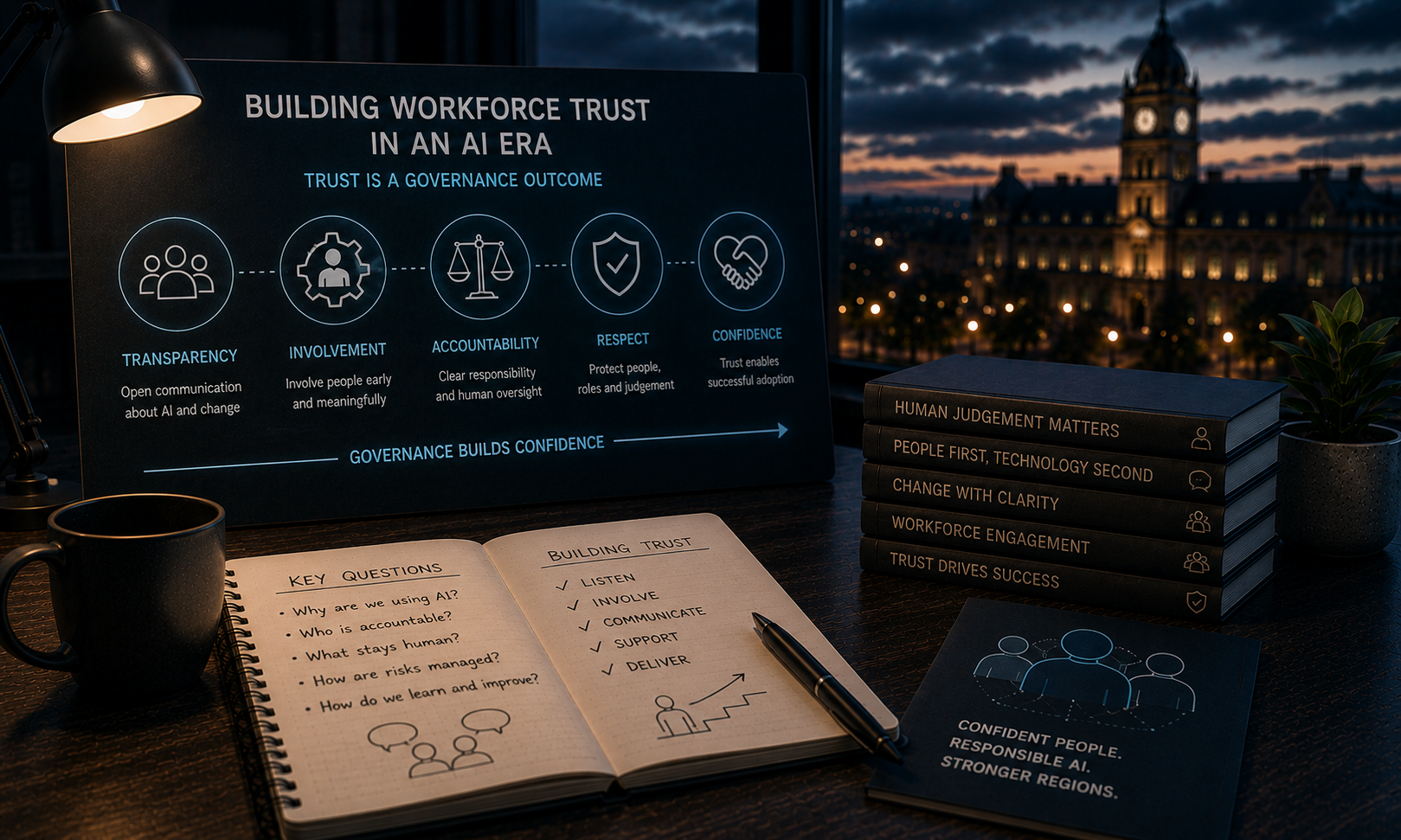
Workforce trust is a governance outcome. It develops when decisions are made transparently, affected people can shape them before they become difficult to reverse, human responsibility is clear and concerns lead to action. A communication campaign cannot substitute for these conditions. Nor can leaders assume that enthusiasm for a pilot means workers trust its wider use.
This paper explains the trust gap between organisational ambitions and workers’ immediate questions, then examines five commitments: earn trust through conduct; involve people early; protect professional judgement; govern continuously; and lead honestly through uncertainty.
Trust is not a promise that every role will stay the same. It is confidence that the institution will make difficult choices fairly, explain them, listen to evidence and honour the obligations it has to the people doing and receiving the work.
Leaders often introduce AI through the language of productivity, service improvement and innovation. Employees may ask different questions: Will the tool change my role? May I reject its output? Who answers for an error? Will my expertise still matter? What information about my work will be collected? These questions are reasonable responses to a change in authority and working conditions.
The trust gap opens when an organisation explains benefits without answering those questions. Staff may attend training and still remain unsure what use is permitted. A clinician may see faster documentation but worry that a plausible summary will conceal an error. A council officer may be asked to use automated recommendations without knowing how to contest them. Such concerns are also evidence about the work; treating them as resistance can deprive leaders of information they need.
The OECD’s surveys of employers and workers found that training and worker consultation were associated with better outcomes for workers using AI. The International Labour Organization has likewise stressed social dialogue in managing the effects of generative AI on work. The practical point is that workers’ knowledge and interests belong inside governance decisions, not merely in communications after them.
When workers expect concerns to be heard, they can report mistakes, challenge a weak assumption and suggest a better use earlier. Their participation improves the institution’s ability to see what a vendor demonstration or executive proposal misses. This is the trust dividend: confidence in governance creates conditions for more candid information and better decisions.
The dividend is conditional. Feedback that never changes a decision can erode trust, as can asking staff to check outputs without time or authority. Reported adoption may reflect compliance rather than confidence. Leaders should examine whether people use the tool appropriately and can raise concerns without penalty.
Trust also predates an AI project. Employees notice whether ordinary decisions have been explained, commitments honoured and errors acknowledged. An organisation with a history of weak consultation cannot repair that history with a polished launch. It can begin building credibility by being specific about the decision still open, the constraints it faces and what will happen with the workforce’s input.
Leadership behaviour gives governance its credibility. Before introducing a tool, leaders should state its purpose, the problem it is meant to solve and the alternatives considered. They should name who owns the use and who can change or stop it. Where effects on roles remain uncertain, that uncertainty should be acknowledged rather than hidden behind assurances that nobody can substantiate.
Consistency matters after launch. If the organisation says human review is required, workloads must allow it. If it promises that reports of error will be examined, someone must investigate and explain the result. Staff will judge the system of governance by these observable actions, especially when a concern is inconvenient. Trust grows through decisions that match the institution’s stated principles.
The people closest to a task know where exceptions arise, what information is missing and why a seemingly efficient step may cause problems later. They can identify when an AI output would need professional checking or when a new workflow would shift effort to a colleague. Their knowledge should shape the problem definition, trial design and criteria for wider use.
Meaningful involvement has a decision to influence. A service team might help select representative cases for testing; workers and their representatives might examine how a proposal changes tasks, monitoring or skill development. Leaders should say which elements are open, what evidence will be considered and how they will respond to competing views. Consultation does not transfer leadership accountability or require consensus. It makes the decision better informed and more legitimate.
Australian workplace consultation requirements depend on the circumstances and applicable instruments. The Fair Work Ombudsman’s guidance recommends a consultation strategy for significant workplace change and recognises the role of employee representatives. Institutions should address their specific duties while treating early participation as a governance capability, even where a minimum legal requirement does not settle what good practice demands.
AI can help clinicians draft records, planners review material and engineers identify patterns. It can also produce fluent but misleading outputs. Protecting judgement means deciding where a person must interpret evidence, weigh context, challenge a recommendation and retain authority over the outcome. It does not mean a human must approve every low consequence automated step.
An organisation should define the boundary for each material use. Which decisions may the system support? What must a worker verify? When is the tool unsuitable? Can the worker override it without facing pressure to meet an automation target? Training should explain limitations as well as features, and review should be designed into the workflow rather than appended to an already full workload.
This protects institutional knowledge. Regional organisations may rely on a few experienced people whose judgement is difficult to replace. If workers merely validate automated output, opportunities to develop expertise can narrow. Leaders should examine how junior staff learn and how professionals act when the tool is wrong.
Approval is the beginning of oversight. Products change, staff find new uses and a pilot can expand into work with greater consequences. The organisation needs a regular way to review performance, errors, worker experience and the effects on people receiving its services. The frequency and depth of review should reflect the significance of the use.
Workers need a dependable route for reporting a problem and seeing it addressed. Leaders should decide what is recorded, who can pause the use and when a change requires a fresh decision. A report of a recurring error may call for better training, a revised workflow, stronger supplier controls or withdrawal of the tool. Reassessment shows that governance remains active after the launch team moves on.
For a smaller regional institution, continuous governance can sit within existing management and risk processes. It requires protected attention and clear authority more than a large new committee. The measure is whether evidence from daily work can reach someone empowered to act.
No leader can predict every effect of AI on tasks, roles or services. Claiming certainty can make later corrections look like broken promises. A more credible account distinguishes what is known, what is being tested, what will be decided later and who will participate in those decisions.
Honesty also applies to difficult workforce implications. If efficiency gains could change staffing or career pathways, workers deserve a serious discussion about the possibilities and the process for decisions. Development opportunities should be real, with time and access to learn, rather than a general instruction to adapt. Leaders can explain constraints while still giving people meaningful notice, representation and a route to challenge assumptions.
Consistency under pressure is the test. An organisation that values transparency must be candid when a trial disappoints. One that values professional judgement must resist rewarding speed when review reveals a problem. Confidence comes from seeing that leaders can revise a decision responsibly, not from hearing that a plan is certain to succeed.
Consider a hypothetical regional service introducing AI to help staff draft responses to residents. A trial shows faster first drafts. Staff also notice that some responses miss local context and that checking them takes longer in complex cases. Leaders have already announced a broad rollout and a productivity target, leaving workers reluctant to report the difficulty.
The five commitments suggest a different course. Leaders would explain the original purpose and acknowledge the new evidence. Staff could identify which requests are suitable for drafting and which require direct human work. Managers would protect review time, measure quality alongside speed and give staff a route to pause inappropriate use. The organisation would decide whether to narrow or redesign the rollout and tell employees why.
This is an illustration, not a report about an actual Ballarat organisation. It shows that trust can grow even when a trial reveals a problem, provided the institution treats the workforce’s evidence as part of governance and changes course when warranted.
Ballarat’s organisations have different obligations and workforces, but they can learn from one another’s approach to consultation, professional oversight and incident response. Appropriate lessons can travel through professional networks without disclosing confidential personnel matters or transferring responsibility for decisions. BRAIN’s Governance Pathway offers a common language: Responsibility and Accountability identify who decides; Stewardship considers workers and communities; Transparency makes choices understandable; Assurance tests practice; Resilience supports correction.
The regional opportunity is to make credible governance visible in multiple workplaces. Examples of honest consultation can improve questions across the region. Each organisation remains responsible for earning trust through its own conduct.
Workforce trust cannot be added after an AI implementation is complete. It grows when leaders involve people while decisions are open, protect their capacity for judgement, examine evidence after deployment and respond honestly to uncertainty. Workers may still disagree with a decision. They should be able to see how it was reached, what will be monitored and how an error can be corrected.
For regional institutions, these practices strengthen both the immediate use of AI and the capability to govern later change. The measure is not whether employees stop asking questions. It is whether their questions can improve decisions and whether leaders remain accountable for the answers.
The Ballarat Region Artificial Intelligence Network (BRAIN) is a regional institution focused on strengthening the capability required for communities and organisations to prosper in the age of artificial intelligence. Its Governance Insights Series offers practical, regionally grounded thinking for boards, executives and institutional leaders navigating AI-enabled change.
Matt Bowd is CEO of BRAIN. His work focuses on AI governance, institutional capability and the implications of artificial intelligence for regional organisations and communities.
International Labour Organization, Generative AI and Jobs: A 2025 Update.
Fair Work Ombudsman, Consultation and Cooperation in the Workplace.
BRAIN Governance Insights Paper No. 5 — Governing AI Procurement and Vendor Relationships. The next paper examines how supplier choices shape accountability, organisational capability and long-term resilience.
Written by Matt Bowd, CEO of the Ballarat Region Artificial Intelligence Network (BRAIN).
Each study is a step toward a more intelligent and resilient region.
To participate in regional pilots or insights partnerships, in our region or yours, connect via matt@brain.net.au.
Your link has expired. Please request a new one.
Your link has expired. Please request a new one.
Your link has expired. Please request a new one.
Great! You've successfully signed up.
Great! You've successfully signed up.
Welcome back! You've successfully signed in.
Success! You now have access to additional content.